Jaw Balance Program · Holistic dentistry
TMJ, jaw pain and teeth grinding treatment in Sharjah
Jaw pain, morning headaches, clicking and a tight neck often share one source: a jaw that works too hard, day and night. The Jaw Balance Program looks at the whole chain, from your teeth to your spine, and uses a custom hard splint to give your jaw a stable, even place to rest.
Start with a jaw check, AED 500, credited to your program.
This information is general. A dentist examines you before recommending any treatment, and your own plan may differ from what is described here.

The Jaw Balance Program at a glance
- What it is
- A treatment program for jaw-joint and jaw-muscle problems (temporomandibular disorders, often called TMJ or TMD) and for clenching and grinding of the teeth (bruxism). Its core is a custom hard stabilization splint, also called an occlusal splint or a hard night guard, worn at night.
- Who it may help
- People with jaw pain, a clicking or locking jaw, morning headaches at the temples, teeth clenching or grinding, worn teeth, or a tight neck along with jaw pain. In children we also check jaw growth and any shift of the jaw to one side.
- What it includes
- A full jaw assessment, including the tongue, the frenum and head posture, a scan and bite record, a splint 3D-printed for your teeth in clear medical resin, a fitting visit, three follow-up and adjustment visits, a home program and a review at three months.
- How long it takes
- About three months from the first assessment to the review, with follow-ups at about 2 weeks, 6 weeks and 3 months.
- Prices
- Jaw check AED 500, credited to your program. Jaw Balance Essential AED 2,900, with one splint; each additional or modified splint is AED 1,000. Jaw Balance Complete AED 4,500: it adds up to 3 splints over 6 months as needed, a CBCT scan of both jaw joints, and a 3D face scan before treatment and at review. Your dentist recommends Complete when a CBCT of the jaw joints is needed.
- Who treats you
- Licensed dentists at aiHealth Medical Center. When your neck, posture, headaches, ears or sleep need another specialist, we refer you to a physiotherapist, physician, ENT or sleep specialist and share our findings.
- What it does not do
- The splint does not stop grinding, reshape bone or straighten the spine. It is designed not to move your teeth.
- Next step
- If your teeth need to move once the jaw is stable, treatment continues with Klaer clear aligners.
Does this sound like you?
Common signs of a jaw that works too hard. Note the ones that apply: it helps you describe your symptoms at your jaw check.
- I wake up with a sore jaw, a tired face or a headache at my temples.
- I clench or grind my teeth, or someone has heard me grinding at night.
- My teeth look worn, flat, chipped or cracked.
- My jaw clicks or pops, and it hurts.
- My jaw sometimes gets stuck, or I can’t open my mouth fully.
- I have pain in front of my ear or a full feeling in it, and my ears were checked and are fine.
- My jaw gets tired when I chew.
- My neck and shoulders feel tight along with my jaw.
- One side of my lower face looks fuller, or my jaw muscles feel bulky.
- My tongue can’t lift to the roof of my mouth, or I (or my child) have been told about a tongue-tie.
- My child’s jaw moves to one side when they close, or their face looks uneven.
This list is not a diagnosis. Only an examination can tell what is behind your symptoms.
Your bite, your jaw and your neck work as one system
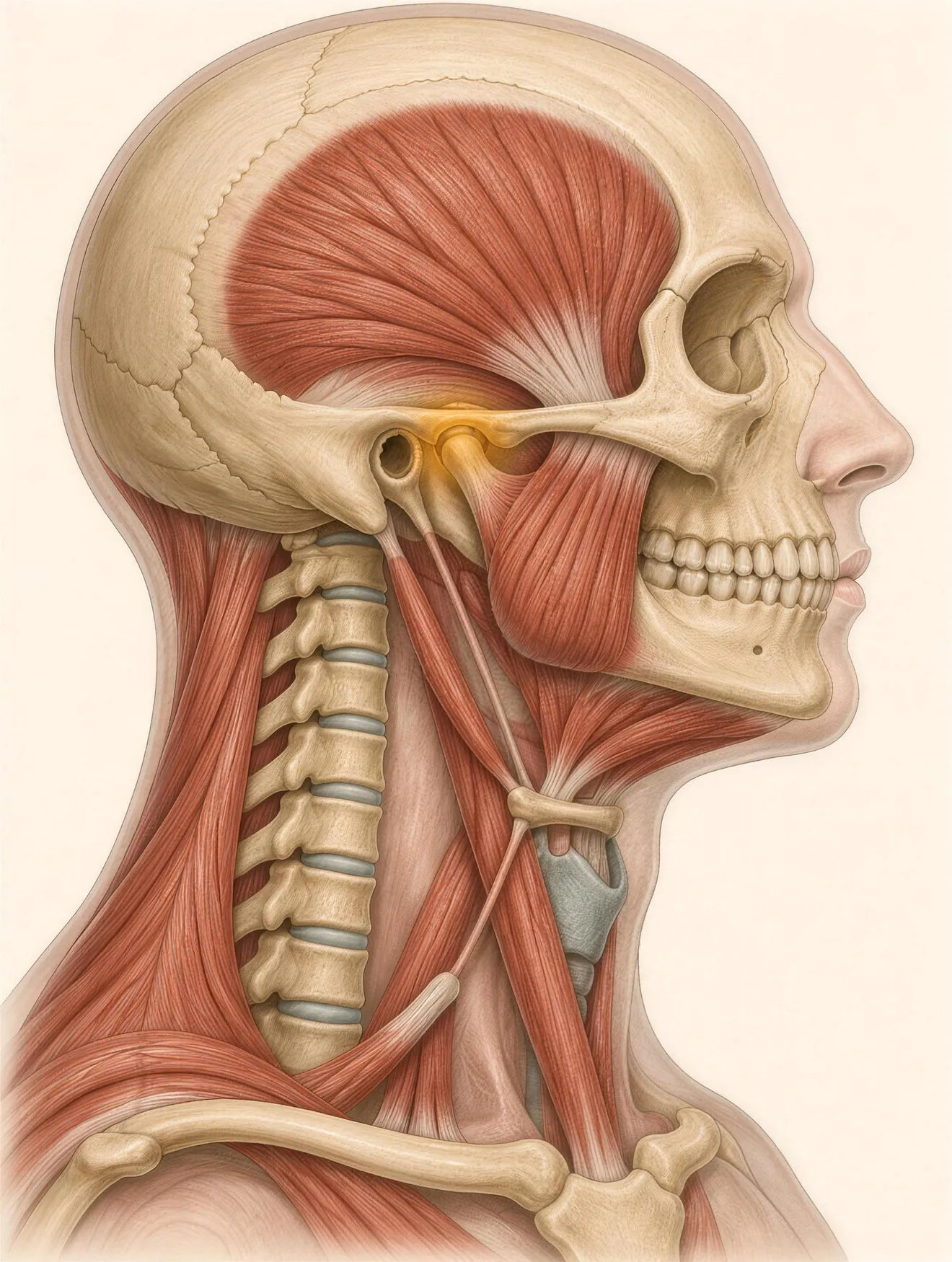
Dentists call it the stomatognathic system: the teeth, the two jaw joints, the chewing muscles, the ligaments that hold the jaw, the hyoid bone in your throat, and the muscles of your neck. They are linked like a chain. A change in one link changes the load on the others.
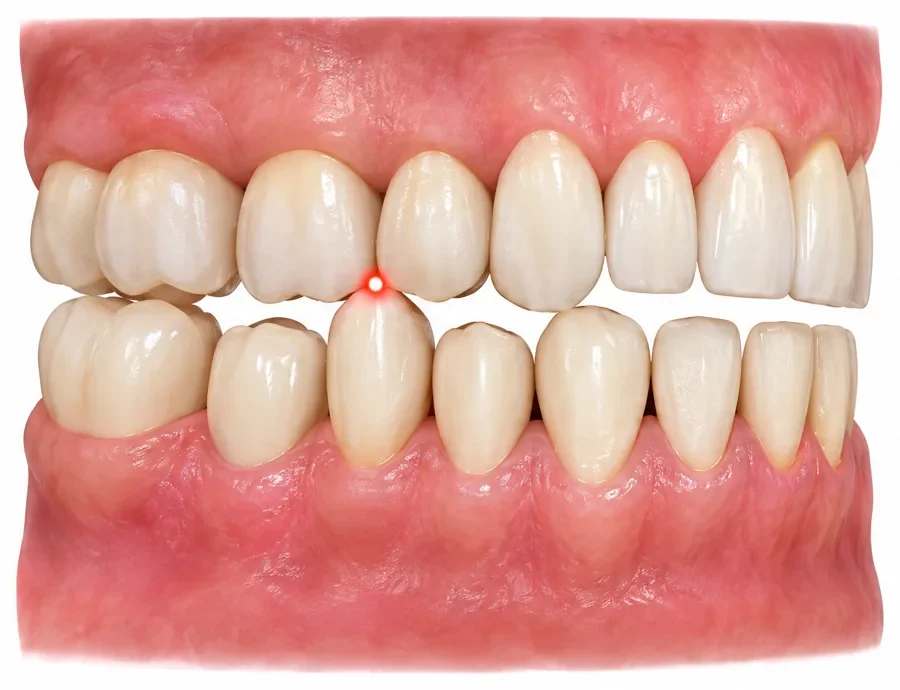
When you close your mouth, your teeth guide the lower jaw into its final position. If one tooth hits first (a high filling, a tipped tooth, missing back teeth, a crossbite), the jaw muscles steer the jaw sideways or forward so the teeth can fit. You close your teeth every time you swallow, so this happens many times a day. Over time it can tire the muscles and load one joint more than the other.
Many people with an imperfect bite never have symptoms. The bite is one factor among several; clenching, grinding, stress, sleep and posture matter as much.
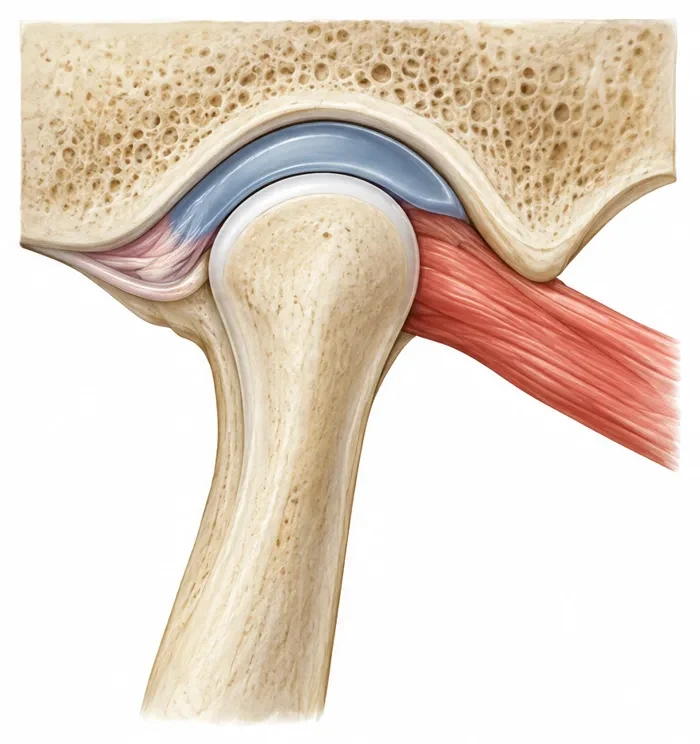
Inside the jaw joint: healthy, click and lock
Each jaw joint has a rounded head (the condyle), a socket in the skull, and a small disc of tough tissue between them. Long hours of clenching press hard on the disc. Over time the tissues that hold it can stretch and the disc can slip forward. That is the click many people hear. If the disc stays forward, it can block the joint and limit opening.
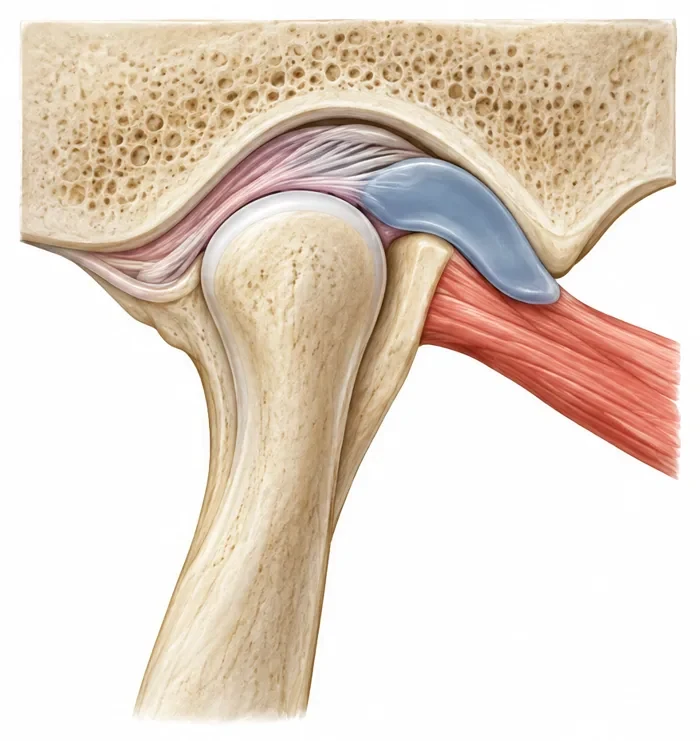
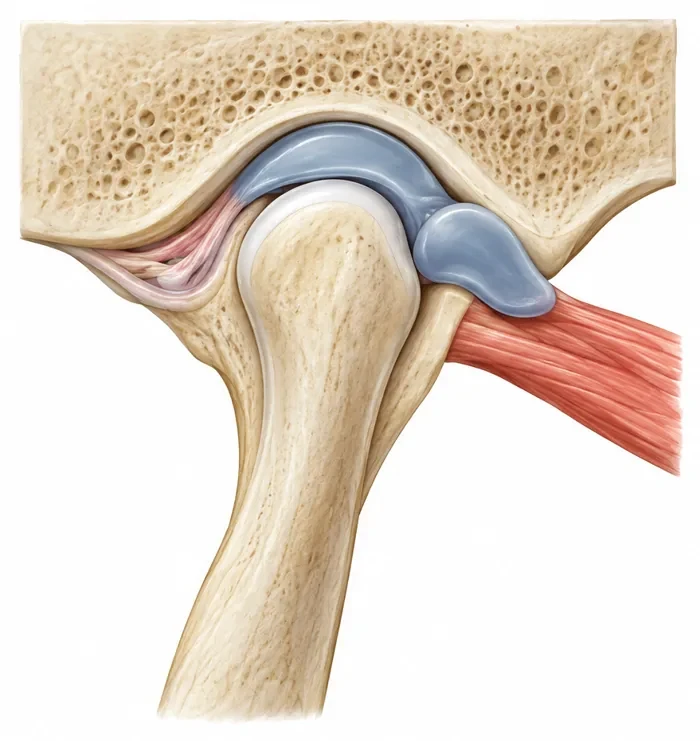
A click that does not hurt or lock is common and often needs no treatment.
A stabilization splint, made for your teeth
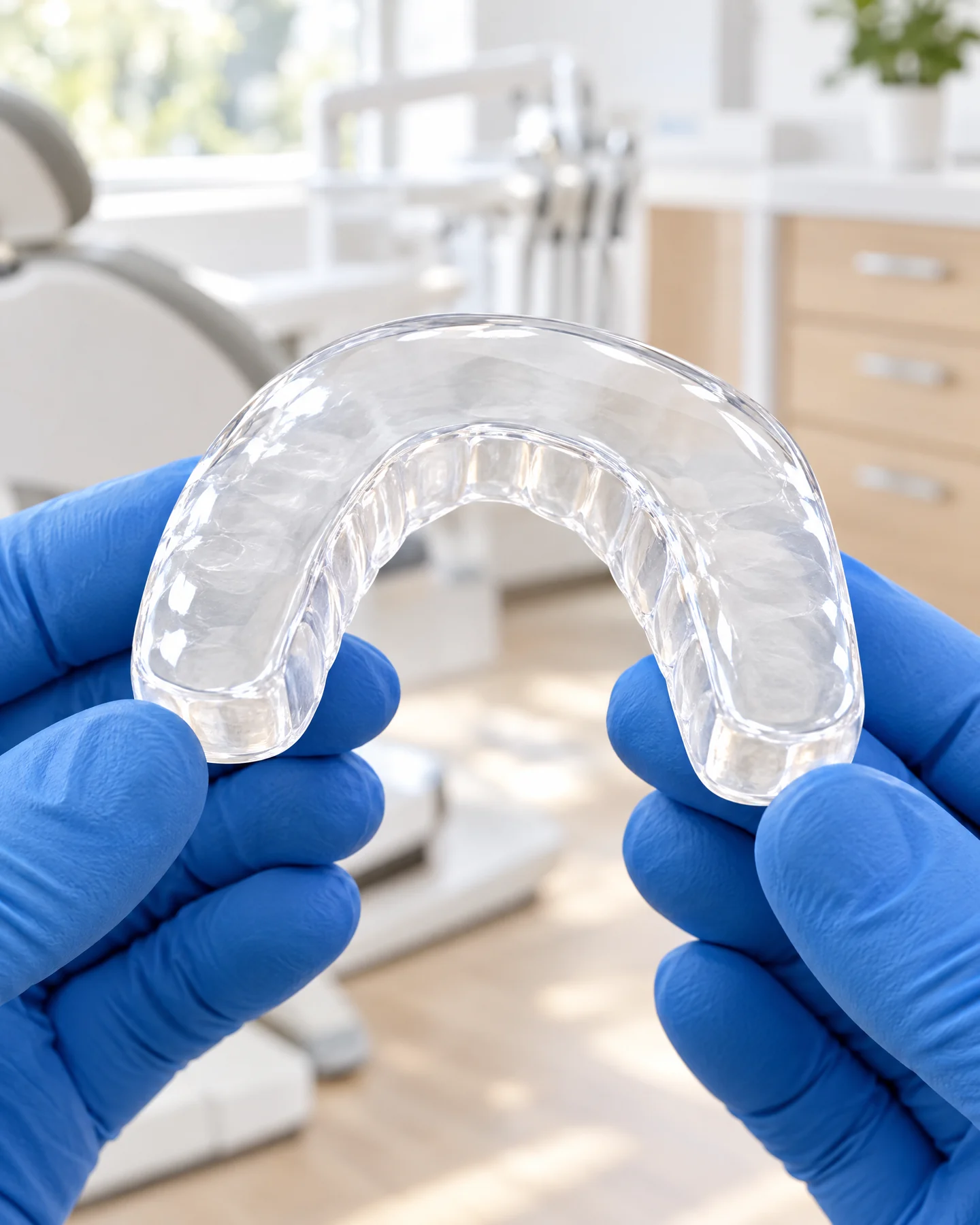
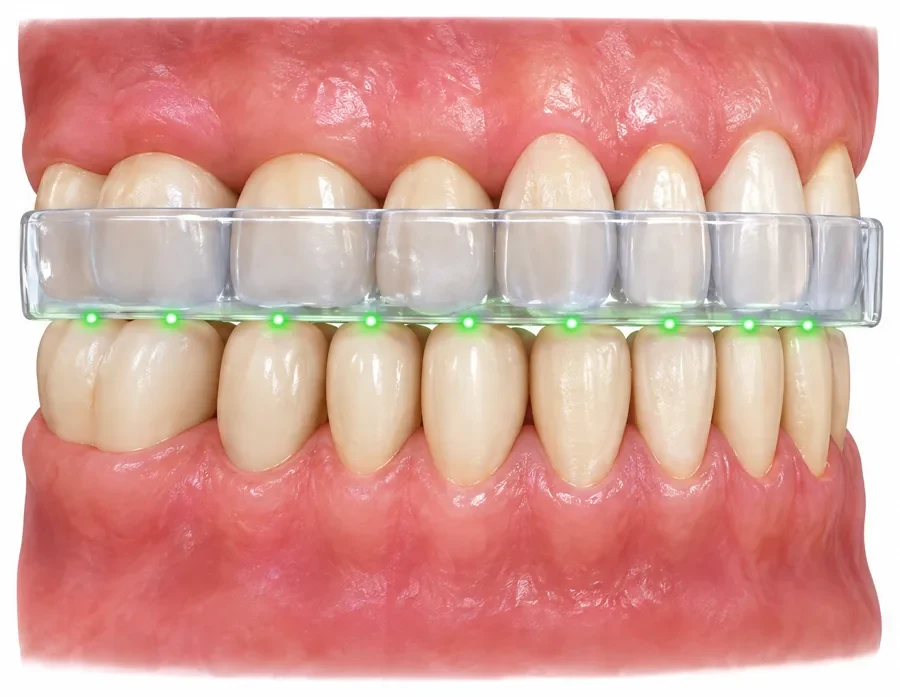
A hard stabilization splint is a thin, rigid plate, 3D-printed in clear medical resin, that fits over all the teeth of one jaw, usually the upper. Its biting surface is smooth and flat, so when you close, your lower teeth touch it evenly on both sides at the same moment. When you slide your jaw sideways, a gentle ramp near the canine teeth lifts the back teeth apart, which helps the closing muscles relax.
What it does
- Protects your teeth from the wear, chips and cracks caused by grinding.
- Spreads biting force evenly across all teeth and both joints.
- Gives the jaw muscles a stable, balanced position. For many patients that means less morning pain and fewer headaches.
- Lowers the pressure on the joint discs.
- Shows us how your symptoms respond, which guides the next step.
What it does not do
- It does not stop grinding. Grinding is driven by the brain during sleep; the splint takes the wear instead of your teeth.
- It is designed not to move your teeth or change your bite.
- It does not reshape bone or straighten the spine.
Hard splint or soft night guard?
Soft guards from a pharmacy or sports shop can protect teeth for a short time, but some people chew on them, which keeps the muscles working, and they cannot be adjusted precisely. A hard splint gives a firm, even surface that we check and adjust at every visit.
If you snore heavily or someone has noticed you stop breathing in your sleep, tell us. Sleep apnoea changes which device is right for you, so we check for it before we make your splint.
How the Jaw Balance Program runs
The splint program is the first step: it brings the jaw, the muscles and the joints into balance. One plan, from the first examination to your three-month review.
- Visit 1 Full assessment
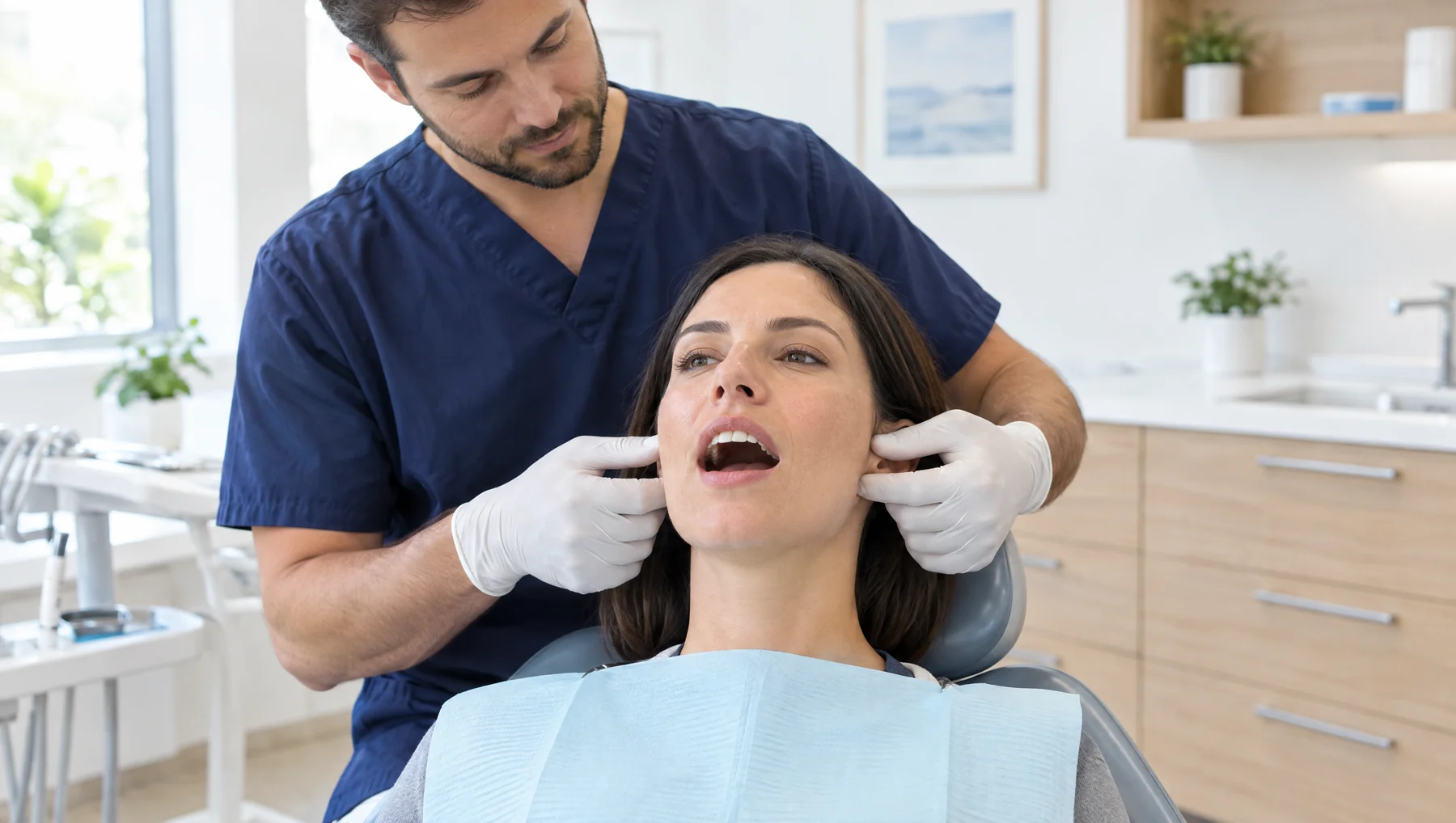
- Your symptoms and headache history; both jaw joints (sounds, opening, how the jaw moves); the chewing and neck muscles; your bite and tooth wear; facial symmetry and head posture; tongue posture and the frenum under the tongue; and in children, jaw growth and any shift to one side. We check for snoring and sleep apnoea. X-rays or a CBCT scan of the joints only if your dentist finds them necessary. In Jaw Balance Complete we also take a 3D scan of your face, before treatment and again at your review. It measures facial symmetry and the bulk of the jaw muscles, so we can see change over time.
- Visit 1 or 2 Scan and bite record
- A scan of your teeth and a record of your bite with the jaw in a relaxed position.
- In the lab Your splint is made
- 3D-printed for your teeth in rigid, clear medical resin.
- Fitting visit Fitting
- We fit the splint, mark every contact with thin coloured paper, and polish it until both sides touch evenly. You leave knowing how to wear it, how to clean it and what to expect.
- At home Your home plan
- Simple habits that support the splint: lips together, teeth apart, tongue resting on the palate; gentle jaw exercises; tips for sleep, screen posture and stress; and a short symptom diary.
- About 2 weeks, 6 weeks, 3 months Follow-up adjustments
- As the muscles relax, the jaw can settle into a slightly different position, so we re-check and adjust the splint.
- 3 months Review
- We repeat the key measurements from your first visit, compare them, and agree the long-term plan together.
- When needed Team care
- If a tight tongue-tie needs releasing, we plan the frenectomy with tongue exercises. If your neck, posture, headaches, ears or sleep need another specialist, we refer you to a physiotherapist, physician, ENT or sleep specialist and share our findings.
Your dentist recommends a program after the jaw check
Prices in UAE dirhams, from November 2026. The dentist decides which program fits after the jaw check, and whether a splint needs remaking. Your written plan confirms the fee before anything starts.
Jaw check: AED 500
An examination of both jaw joints, the jaw and neck muscles, your bite and tooth wear, with your symptoms and headache history. You leave knowing what is likely behind your symptoms and which program fits.
Credited to Essential or Complete when you go ahead.
Jaw Balance Essential: AED 2,900
The splint program, from assessment to the 3-month review.
- Full jaw assessment
- Tongue and frenum assessment, and head and neck posture screening
- Intraoral scan and bite record
- One custom 3D-printed hard splint
- Fitting visit
- Three follow-up and adjustment visits
- The 3-month review
- Home program: daily habits, gentle jaw exercises and a symptom diary
Jaw Balance Complete: AED 4,500
Everything in Essential, with up to 3 splints over 6 months and 3D imaging of the joints and the face.
- Everything in Jaw Balance Essential
- Up to 3 splints over 6 months, as needed
- CBCT scan of both jaw joints: it shows the bone of the joints and any wear in it
- 3D face scan before treatment and at your review: it measures facial symmetry and the bulk of the jaw muscles, so we can see change over time
Your dentist recommends Complete when a CBCT of your jaw joints is needed. CBCT shows bone, not the disc; an MRI shows the disc, and your dentist will tell you if you need one.
Each additional or modified splint: AED 1,000. Routine adjustments at your follow-up visits are included.
Add-on: tongue-tie release
Only when your dentist finds a tight frenum that limits your tongue. Decided case by case, planned with tongue exercises (myofunctional therapy) beforehand and afterwards, and priced in your written plan.
Next, if needed: Klaer clear aligners
If your teeth need to move once the jaw is stable, we continue with Klaer clear aligners, planned from a relaxed, stable jaw position. Your full program fee is credited toward Klaer. Read about orthodontics and clear aligners
Why we look beyond the teeth
Holistic dentistry means treating the mouth as part of the whole body, so we do not stop at the teeth: we look at your muscles, joints, posture, sleep and stress, because each of them changes the load on your jaw.
Head posture and the neck
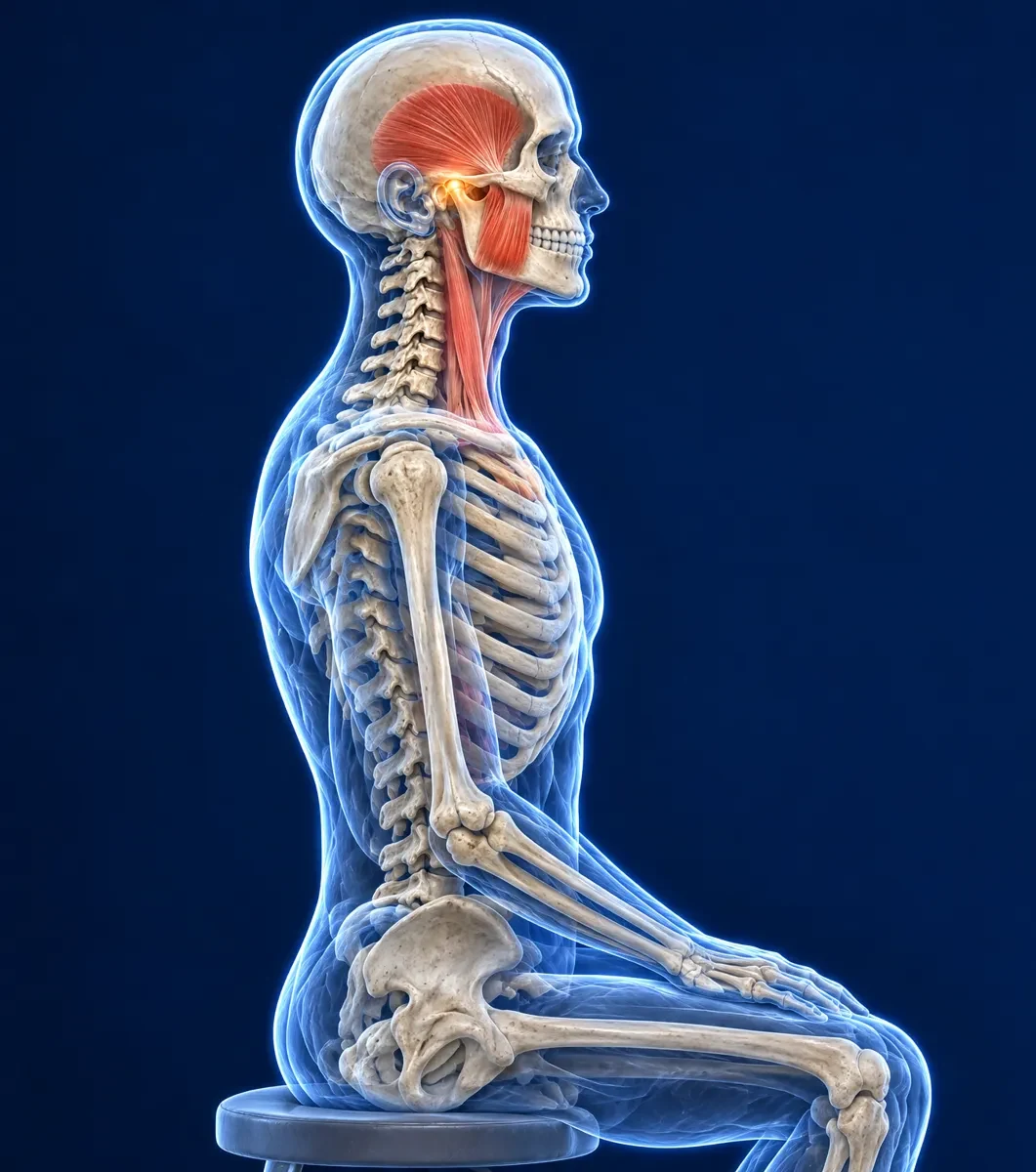
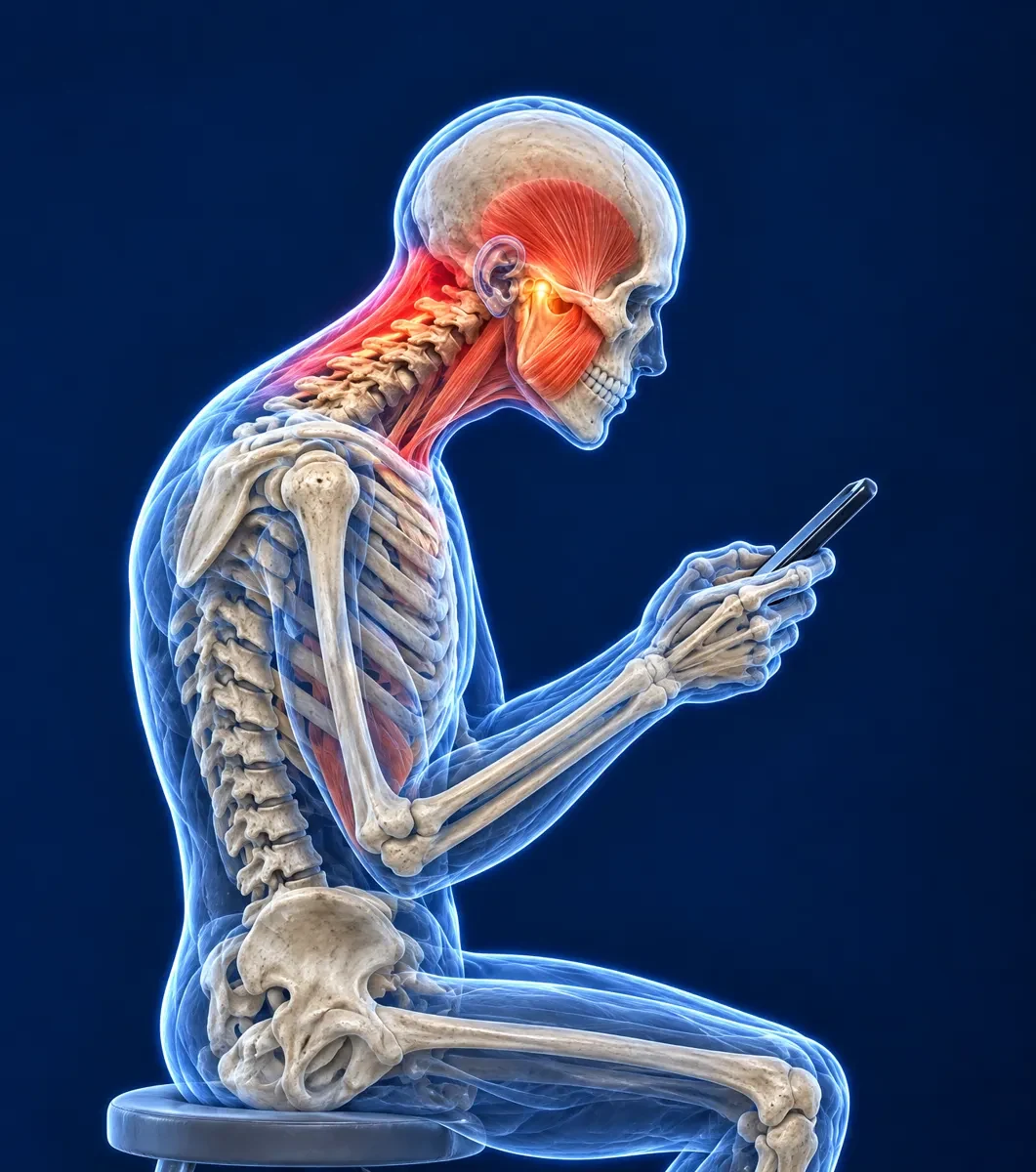
Your head sits on the neck like a ball balanced on a stick. Muscles behind the neck pull back, while the jaw and throat muscles pull from the front. When the head drifts forward, for example during long hours at a phone or desk, the neck muscles work harder to hold it up, and the jaw and hyoid muscles change length.
The jaw and the upper neck also share a pain pathway. Nerve signals from the face and jaw (the trigeminal nerve) and from the top three neck nerves meet in the same area of the brainstem. That is why a stiff neck can be felt as jaw or head pain, and why jaw problems often come with neck pain.
The tongue and the frenum under it
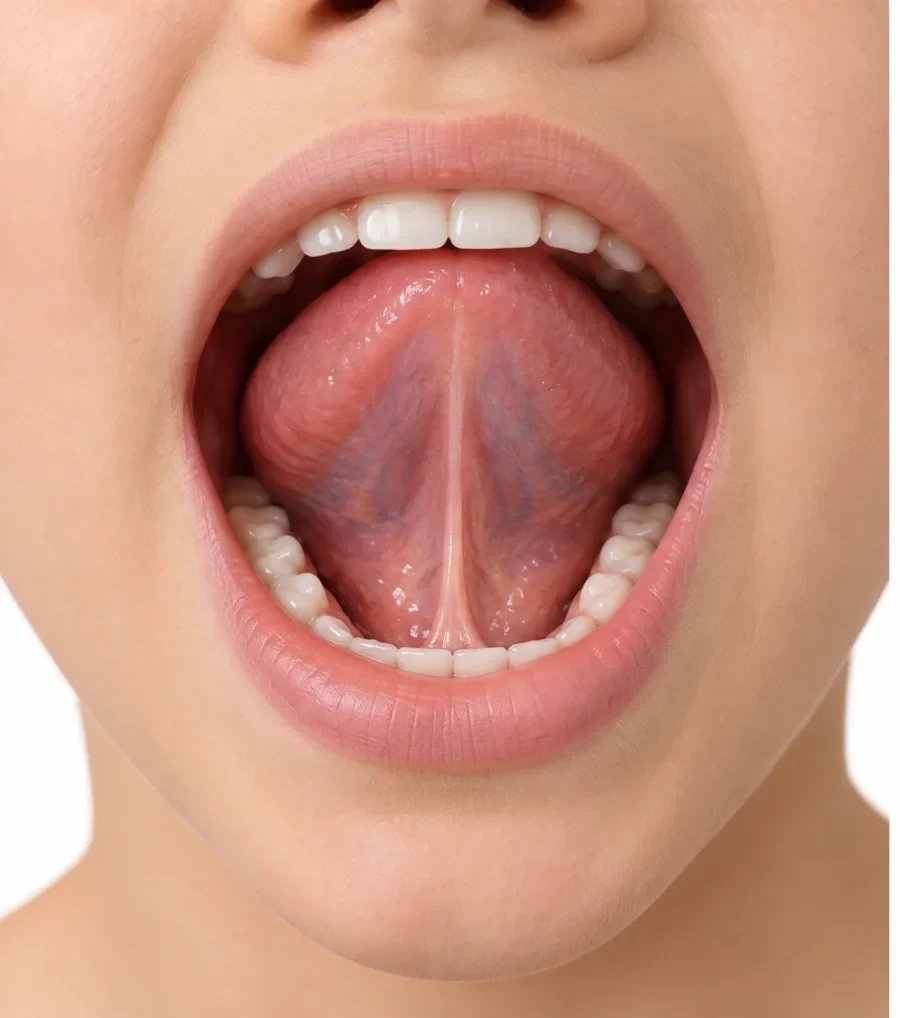
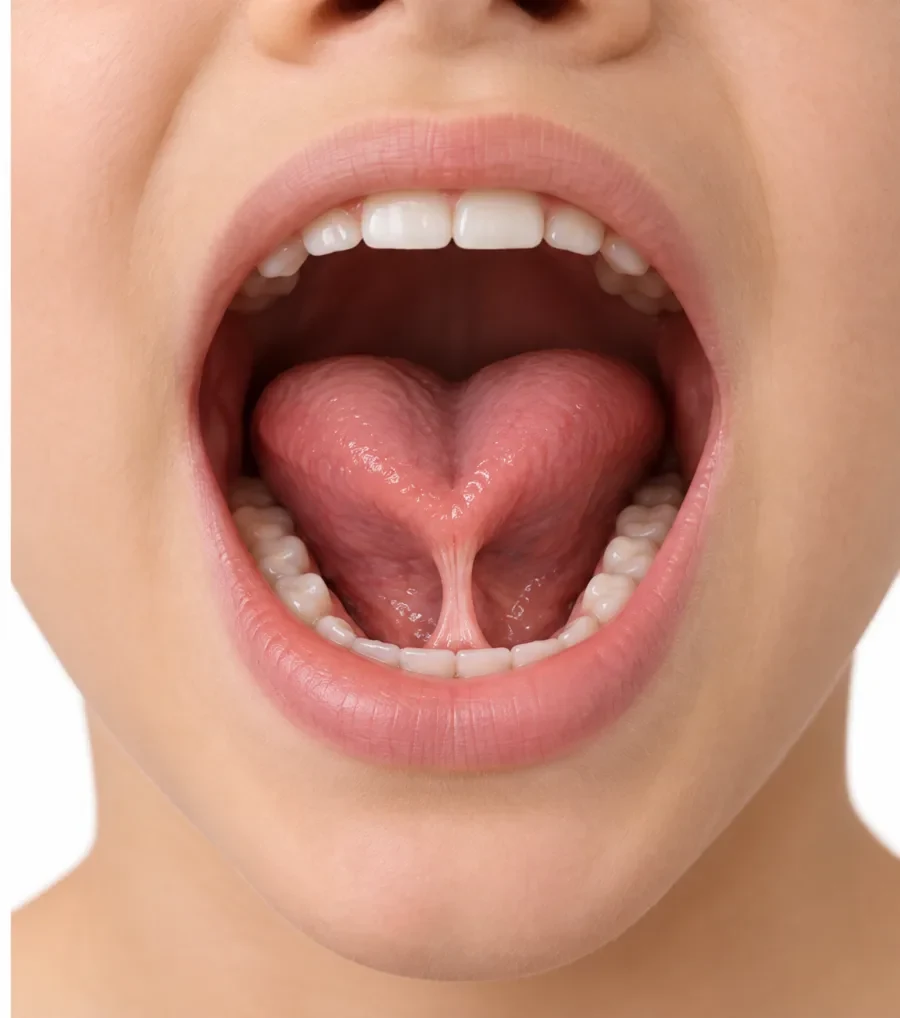
At rest the tongue should lie up against the roof of the mouth, with the lips closed and breathing through the nose. In a growing child, that gentle, constant pressure helps the upper jaw grow to its full width.
Under the tongue is a thin fold of tissue called the lingual frenum. In some people it is short or tight (tongue-tie) and holds the tongue down. The tongue then rests low, the upper jaw can grow narrow, and the teeth may meet in a crossbite that pushes the lower jaw to one side.
Not every short frenum needs treatment. When it does limit the tongue, a frenectomy releases it. It is a short procedure, usually under local anaesthetic, done together with tongue exercises (myofunctional therapy) beforehand and afterwards, so the tongue learns its new resting position.
What about an S-shaped spine?
Scoliosis is a sideways curve of the spine. In some studies, jaw-joint problems and uneven bites are more common in people with scoliosis, and the link may run both ways through posture and muscle balance. But research has not shown that a jaw problem causes scoliosis, or that a splint straightens the spine. If we see signs of a spinal curve during your assessment, we refer you to a physiotherapist or spine specialist and work alongside them.
Facial symmetry and growth
Muscles grow with work. Months of heavy clenching can enlarge the masseter, making the lower face look wider and more square. If you chew or clench more on one side, that side’s masseter can grow larger, and one side of the lower face looks fuller. A bite that pushes the jaw to one side as you close can also move the chin slightly off centre.
In children and teenagers the lower jaw is still growing, and its main growth centres sit in the two jaw joints. If the jaw is pushed to one side every time the child closes, the two sides can grow unevenly. Treated early, by balancing the bite, widening a narrow upper jaw and releasing a tight tongue where needed, the jaw can grow more evenly.
At our clinic we have treated many patients whose facial asymmetry improved, and in many cases resolved, once the bite, the jaw position and the tongue were treated together. How much changes depends on age and on the cause, which is why we assess early.
In adults, a splint lowers the overload on these muscles. When overworked muscles are the cause, they may settle over months; results vary, and we will tell you what to expect after your assessment. A splint on its own cannot change the shape of bone. If an adult’s asymmetry comes from the jaw bones themselves, the plan adds orthodontic treatment and, in some cases, a surgical opinion.
What we know, and what is still open
We want you to know what the science supports, and where it is still unclear.
- Accepted
- A hard splint protects the teeth from damage caused by grinding.
- Accepted
- The jaw muscles and joints can cause headache. It is listed in the international headache classification (ICHD-3).
- Accepted
- The jaw and upper neck share pain pathways, and neck pain is common in people with jaw-joint disorders.
- Helps many
- Splints reduce jaw pain and headaches for many patients. Study results are mixed, and splints help more as part of a combined plan with self-care and exercises.
- Helps many
- In growing children, correcting a bite that pushes the jaw to one side helps the jaw grow more evenly. Earlier is better.
- Case by case
- Releasing a tight tongue-tie, with tongue exercises, helps selected patients. Its effect on jaw growth is still being studied.
- Debated
- How much the bite and body posture cause jaw-joint disorders.
- Not proven
- That jaw problems cause scoliosis, or that a splint corrects the spine or the shape of the facial bones.
See a doctor straight away if you have
- A sudden, severe headache, the worst you have ever had.
- Headache with fever, a stiff neck, confusion, weakness, numbness, or changes in vision or speech.
- A new headache after age 50, or one that keeps getting worse.
- Jaw pain with chest pain, shortness of breath or sweating.
- Swelling of the face or jaw, or a jaw that suddenly will not close.
This page gives general information and does not replace an examination. Every patient is different, and results vary. The pictures on this page are illustrations and do not show real patients or results.
Questions about TMJ treatment and the hard splint
How much does TMJ treatment cost at aiHealth in Sharjah?
A jaw check is AED 500 and is credited to your program if you go ahead. Jaw Balance Essential costs AED 2,900: the full assessment, including the tongue, the frenum and head posture, an intraoral scan and bite record, one custom 3D-printed hard splint, the fitting, three follow-up and adjustment visits, the 3-month review and a home program. Each additional or modified splint is AED 1,000; routine adjustments at your follow-up visits are included. Jaw Balance Complete costs AED 4,500 and adds up to 3 splints over 6 months as needed, a CBCT scan of both jaw joints, and a 3D face scan before treatment and at review. Your dentist recommends Complete when a CBCT of the jaw joints is needed.
What is the difference between a hard splint and a night guard?
Many people use the two names for the same thing. Soft guards from a pharmacy or sports shop can protect teeth for a short time, but some people chew on them, which keeps the muscles working, and they cannot be adjusted precisely. A hard stabilization splint, also called an occlusal splint, is 3D-printed for your teeth in rigid medical resin, with a flat surface your lower teeth touch evenly, and we check and adjust it at every visit.
Will the splint stop me grinding my teeth?
No. Grinding is driven by the brain during sleep. The splint takes the wear instead of your teeth, spreads the biting force evenly and gives the jaw muscles a stable position. For many patients that means less morning pain and fewer headaches.
How long do I wear the splint each day?
Usually every night while you sleep, or as your dentist advises. The first few nights you may notice extra saliva or slight pressure on the teeth; this usually settles within a week. How quickly symptoms ease varies from person to person, so we compare your symptoms at each follow-up and at the 3-month review.
Will a splint move my teeth or change my bite?
It is designed not to. In the morning your bite may feel slightly different for a short while. If it still feels different later in the day, call us.
My jaw clicks. Do I need treatment?
A click that does not hurt or lock is common and often needs no treatment. A click with pain, or a jaw that gets stuck or will not open fully, is worth an examination.
Do I need a CBCT scan or an MRI?
Not always. A CBCT scan shows the bone of the jaw joints and any wear in it; it does not show the disc. An MRI shows the disc. Your dentist decides which imaging you need, if any. Jaw Balance Complete includes a CBCT scan of both jaw joints, and your dentist recommends it when that scan is needed.
Can a splint fix scoliosis or an uneven face?
A splint does not straighten the spine or reshape bone. In some studies, jaw-joint problems are more common in people with scoliosis, but research has not shown that one causes the other. In adults, a splint lowers the overload on the jaw muscles, which may settle over months. At our clinic we have treated many patients whose facial asymmetry improved, and in many cases resolved, once the bite, the jaw position and the tongue were treated together; how much changes depends on age and on the cause.
Do you treat tongue-tie?
Case by case. Not every short frenum needs treatment. When it does limit the tongue, a frenectomy releases it: a short procedure, usually under local anaesthetic, done together with tongue exercises beforehand and afterwards. It is priced in your written plan.
What happens after the three months?
At the 3-month review we repeat the key measurements from your first visit, compare them and agree a long-term plan with you. If your teeth need to move once the jaw is stable, we continue with Klaer clear aligners, planned from that relaxed jaw position, and your full program fee is credited toward them.
Where is the clinic?
aiHealth Medical Center is in Office 106 on the first floor of the Halwan Building, Wasit Street, Al Abar, Sharjah, with parking behind the building. It is open every day from 9:00 AM to 10:00 PM, for patients from Sharjah, Ajman and the northern emirates.
Start with a jaw check
AED 500, credited to your program. Book online and our team will call to confirm, or send us a message on WhatsApp.
Sources
- Headache Classification Committee of the International Headache Society. The International Classification of Headache Disorders, 3rd edition (ICHD-3), code 11.7. Cephalalgia. 2018;38(1):1–211.
- Schiffman E, Ohrbach R, Truelove E, et al. Diagnostic Criteria for Temporomandibular Disorders (DC/TMD) for clinical and research applications. J Oral Facial Pain Headache. 2014;28(1):6–27.
- Okeson JP. Management of Temporomandibular Disorders and Occlusion. 8th ed. Elsevier; 2019.
- Riley P, Glenny AM, Worthington HV, et al. Oral splints for patients with temporomandibular disorders or bruxism: a systematic review and economic evaluation. Health Technol Assess. 2020;24(7):1–224.
- Lobbezoo F, Ahlberg J, Raphael KG, et al. International consensus on the assessment of bruxism: report of a work in progress. J Oral Rehabil. 2018;45(11):837–844.
- Bogduk N, Govind J. Cervicogenic headache: an assessment of the evidence on clinical diagnosis, invasive tests, and treatment. Lancet Neurol. 2009;8(10):959–968.
- Manfredini D, Castroflorio T, Perinetti G, Guarda-Nardini L. Dental occlusion, body posture and temporomandibular disorders: where we are now and where we are heading for. J Oral Rehabil. 2012;39(6):463–471.
- Rocha CP, Croci CS, Caria PH. Is there relationship between temporomandibular disorders and head and cervical posture? A systematic review. J Oral Rehabil. 2013;40(11):875–881.
- Saccucci M, Tettamanti L, Mummolo S, et al. Scoliosis and dental occlusion: a review of the literature. Scoliosis. 2011;6:15.
- Pinto AS, Buschang PH, Throckmorton GS, Chen P. Morphological and positional asymmetries of young children with functional unilateral posterior crossbite. Am J Orthod Dentofacial Orthop. 2001;120(5):513–520.
- Kennedy DB, Osepchook M. Unilateral posterior crossbite with mandibular shift: a review. J Can Dent Assoc. 2005;71(8):569–573.
- Messner AH, Walsh J, Rosenfeld RM, et al. Clinical consensus statement: ankyloglossia in children. Otolaryngol Head Neck Surg. 2020;162(5):597–611.
- Yoon AJ, Zaghi S, Ha S, et al. Ankyloglossia as a risk factor for maxillary hypoplasia and soft palate elongation: a functional-morphological study. Orthod Craniofac Res. 2017;20(4):237–244.
- Zaghi S, Valcu-Pinkerton S, Jabara M, et al. Lingual frenuloplasty with myofunctional therapy: exploring safety and efficacy in 348 cases. Laryngoscope Investig Otolaryngol. 2019;4(5):489–496.