Sugar-free does not mean cavity-free: the acid attack you are missing
Diet sodas, sparkling waters and "no added sugar" juices can still erode your teeth. Here is why, and what to do about it without giving up your favourites.
A patient in his late twenties hands me a list. He has cut out chocolate, switched from regular cola to the zero-sugar version, replaced fruit juice with sparkling water, and started drinking apple cider vinegar in the morning "for health." He is proud of the list. His upper front teeth are translucent at the edges, his lower premolars have shallow cupped lesions on the cusps, and he has three new cavities since his last visit.
He has not added sugar to his diet. He has added acid. And acid, not sugar, is what dissolves enamel.
The actual chemistry of a cavity
Tooth enamel is mostly hydroxyapatite, a calcium phosphate crystal. It is stable above a pH of about 5.5. Below that, it dissolves. Sugar causes cavities because oral bacteria ferment sugar and produce lactic acid as a by-product — the lactic acid is the actual culprit, not the sugar molecule itself. This is the "Stephan curve" your dentist may have mentioned: every sugar exposure drops your mouth's pH for 20 to 40 minutes before saliva buffers it back to neutral.
The problem with sugar-free acidic drinks is that they skip the bacterial step entirely. You are pouring the acid in directly. Diet cola sits at pH 3.0. Sparkling water with lemon is closer to 3.5. Kombucha is 2.5 to 3.5. Apple cider vinegar diluted in water is around pH 3.0. All of them are below the dissolution threshold of enamel. Lussi and Carvalho (Caries Res, 2014) demonstrated that the erosive potential of a drink is a function of its pH, its buffering capacity, and how long it stays in contact with the teeth — not whether it contains sugar.
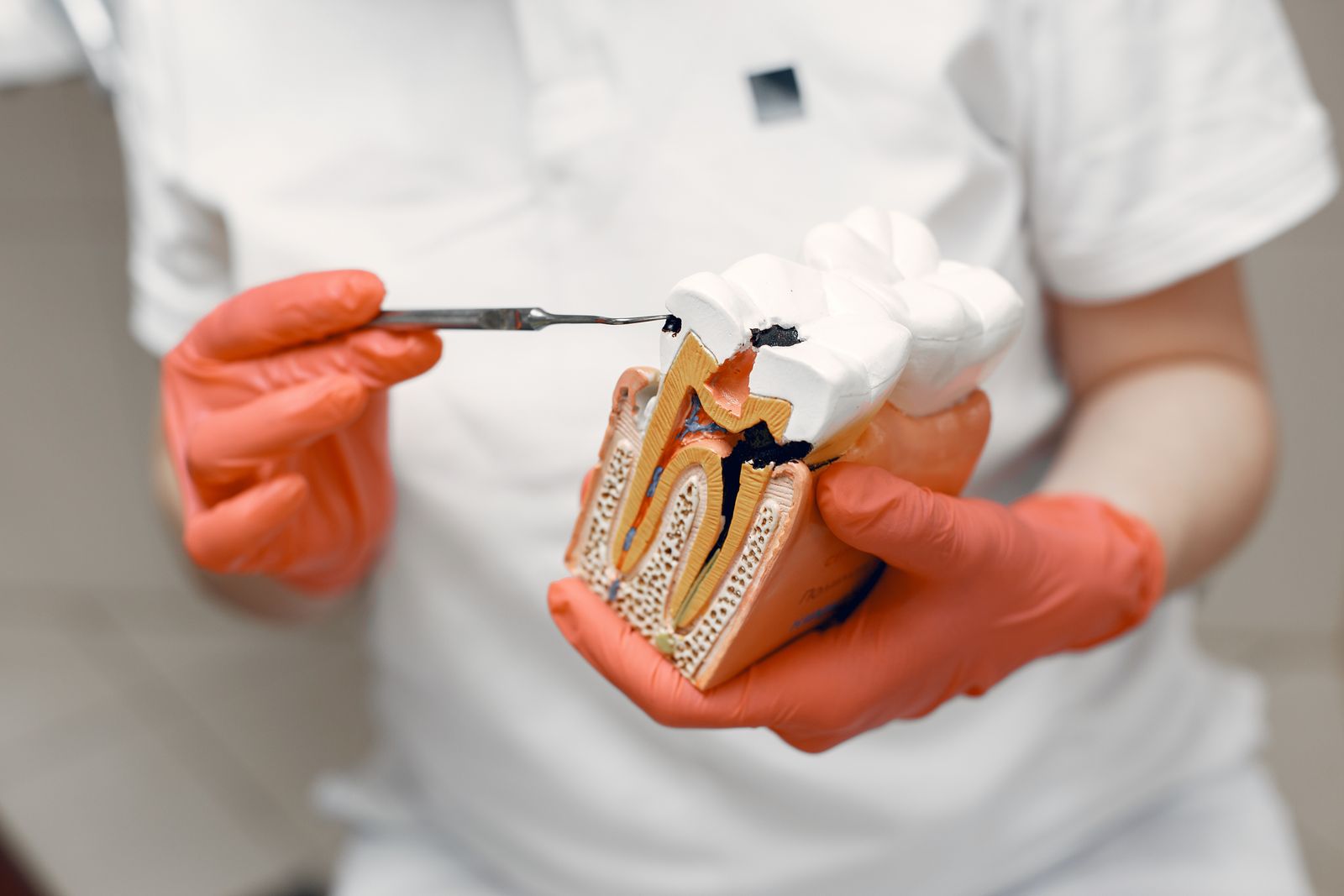
Erosion looks different from a classic cavity — flat, cupped lesions on the cusps and a glassy translucence at the incisal edges.
What erosion looks like in the chair
Classic decay produces dark, sticky lesions in pits and fissures. Erosion looks completely different. Patients come in with thinning at the incisal edges of the upper front teeth, often with a slight translucence you can see when you stand them in front of a window. The lower premolars develop shallow saucer-shaped lesions on the cusp tips — the surface where the cusp meets the saliva pool when the patient swallows. Restorations start to "stand proud" of the tooth because the surrounding enamel has dissolved. By the time the patient notices sensitivity, the dentine is exposed.
What you can do without giving up the drink
You do not have to stop drinking sparkling water or your morning lemon water. Three small changes meaningfully reduce the damage. First, drink the acidic beverage with a meal rather than between meals — food buffers the pH and increases saliva flow. Second, drink it through a straw if you can; this bypasses the front teeth. Third, do not brush for at least thirty minutes after — your enamel is softened, and brushing immediately scrapes it away. Rinse with plain water, wait, then brush.
If you have already developed visible erosion, we can sometimes restore the lost surface with bonded composite at AED 350 to AED 600 per tooth, but the better answer is to identify the source and slow it down. Bring your full diet history to your next hygiene visit — including the things you have added "for health." Most Sharjah patients I see with erosion have one specific drink they did not realise was the problem.
SOAbout the author
Dr Sara Odeh
General Dentist · aiHealth Medical Center
GeneralHygieneErosionView profile →Read more articles on the dental health blog, or book an appointment.